Controlled request queue
Only one request runs at a time. Responses such as 401, 403, 429 and 503 pause the process; Retry-After is respected when available. The tool does not bypass access controls.
07 / Released research tool / Firefox
A local research layer for the public DOJ Epstein Library: inspect document links, test plausible format variants and keep every result organised inside Firefox.
Independent experimental project. Not affiliated with or endorsed by Mozilla or the US Department of Justice.

The research problem
The starting point was a recurring archive pattern: entries that show a placeholder instead of the expected content. Testing another file extension can sometimes expose a reachable representation, but a response alone does not prove that it belongs to the original entry.
The product therefore became a complete research workbench: it remembers checked URLs, preserves working originals, records outcomes and lets the researcher add tags, notes and favourites. It changes only the researcher’s browser view; it never modifies DOJ records.
System architecture
Version 2.0.3 removed the earlier companion-program concept. The complete workflow now lives in a signed Firefox WebExtension and stores its state in the active browser profile.
Content scripts identify eligible document links on search and result pages.
URLs are validated, credentials are rejected and controlled extension candidates are derived.
Requests run sequentially. Response headers and at most 64 KiB of content are inspected.
The workbench distinguishes meaningful content from HTML error pages and access challenges.
Results, metadata and annotations are committed to browser.storage.local.
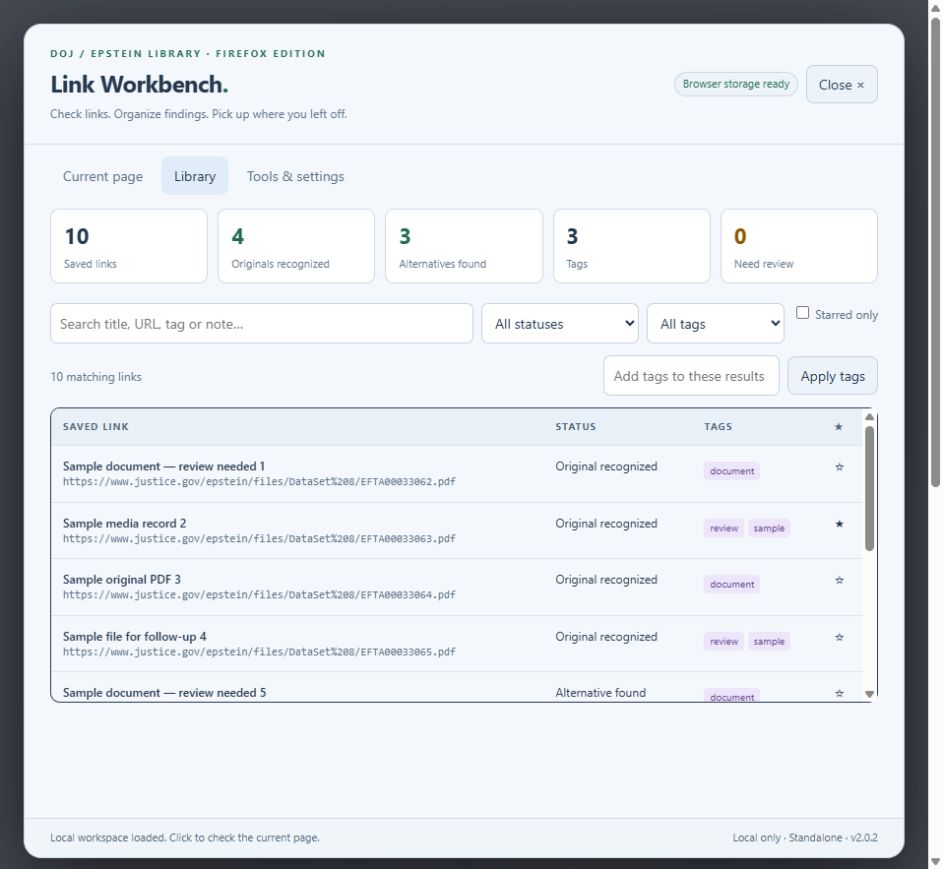
The local library exposes search, filters, tags, notes, favourites and deliberate exports.
Interface layer
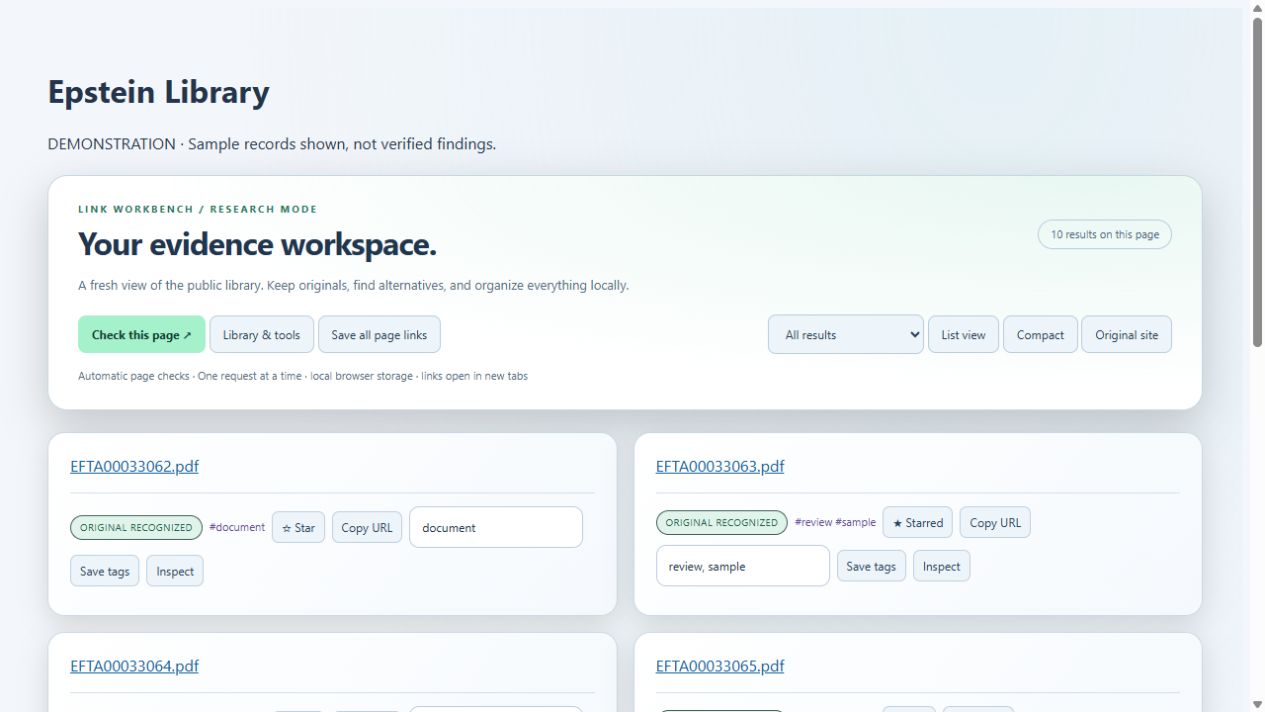
The extension adds list and grid views, status filters, per-result actions and start/stop controls directly to the archive workflow. Documents open in a new tab so the results page remains the stable research surface.
Storefront screenshots use demonstration data and do not represent verified archive findings.
Engineering decisions
Only one request runs at a time. Responses such as 401, 403, 429 and 503 pause the process; Retry-After is respected when available. The tool does not bypass access controls.
Content inspection stops after 64 KiB. Cached outcomes avoid repeated work; debounced search and a capped visible result set keep larger libraries responsive.
User-dependent content is inserted through explicit DOM APIs rather than innerHTML. URLs, internal messages, stored records and imported backups are validated before use.
No account, remote database or automatic synchronisation is required. CSV supports analysis; JSON provides an explicit backup and transfer path.
Interpretation boundary
A successful alternative URL indicates only that the server returned content for that address. It does not establish authenticity, provenance or a relationship to the original placeholder. Link Workbench records technical observations; it does not make evidentiary claims.
Release engineering
Mozilla approved the current package for public distribution after automated review. Firefox verifies the signed XPI during installation. The add-on remains experimental and may be reviewed manually later.